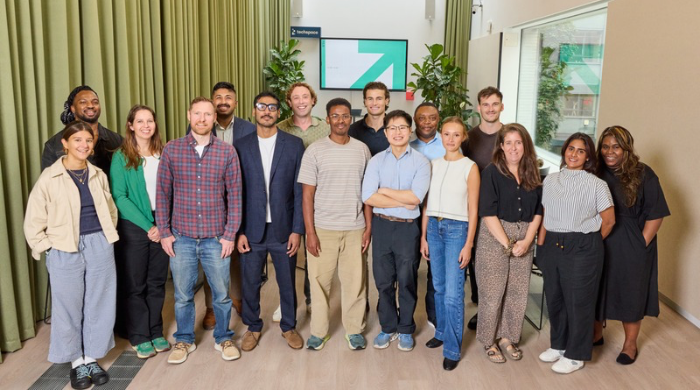
Announcing our Autumn 2026 cohort

Last week we welcomed 12 companies to our Autumn 2026 Tech for Good programme. This cohort was selected from the highest number of applications we’ve received to date, and we’re very excited to support them as they start the programme and take their ventures off the ground. From nurses in emergency wards seeing patients fall through the same discharge gaps for years, to a neurodivergent professional dealing with the complexity of information on their terms, to engineers protecting forests from wildfires and more, these companies are working towards a more sustainable planet, healthy lives and an inclusive and resilient society.
We're also delighted that we’re continuing our partnership with Vestd and HSBC Innovation Banking on this programme, giving founders access to expert support to grow their businesses.
Without further ado, meet our Autumn 2026 cohort:
Clausemap
Inclusive Society | Tamsira Nwitua
Legal documents are built around dense, linear text, a format that can drive cognitive overload, mental fatigue, and burnout in dyslexic and neurodivergent professionals. ClauseMap is a neurodivergent-centred legal AI platform turning contracts into visual maps, with explainer videos, easy-to-read summaries and calming digital overlays, allowing legal teams to review the fine print without the burnout.
GreenGuard Tech
Sustainable Planet | İpek Üremek, Semih Aslan Sağlamol
Wildfires are becoming more frequent and more destructive, yet most forestry operators and land managers still rely on aerial or satellite monitoring that only detects a fire once it has already taken hold. GreenGuard Tech combines IoT sensor networks with AI-driven forecasting, offering a low-cost wildfire early-detection platform providing real-time, ground-level warning of fire risk well before flames spread.
Hunique
Healthy Lives | Alice Tyler, Andy Kilner
Tricky conversations at work, at home, or in relationships are something everyone faces but rarely feels equipped for. Hunique is a communication skills tool that helps people prepare for these moments, through reflective chat, bite-sized skills practice and role play. It builds real confidence and improves the chances of a better outcome, in the conversation and beyond.
Maricene
Sustainable Planet | Farhan Aslam, Kartikay Dhingra
Conventional biofuel production competes directly with food crops for arable land and fresh water, a trade-off that limits how far the sector can scale sustainably. Maricene has engineered a genetically modified marine yeast that converts seaweed into biofuel, unlocking a pathway for a lower-carbon future.
Noticed
Inclusive Society | Ben Austen, Dominic Markham, and Tara Markham
A student who misses even a few days of school can return to dozens of missed learning objectives, and without a clear picture of exactly what was taught, that gap tends to widen rather than close. Noticed is an AI platform closing knowledge gaps from absence or in-lesson disengagement without adding to the teacher’s workload.
Nurevo
Healthy Lives | Chak Lam Ip, Lok In (Owen) Lo
Alzheimer's disease is typically diagnosed only after significant cognitive decline has already occurred. Nurevo is building a multimodal AI platform for earlier detection, bridging clinical research and daily care to catch signs of the disease sooner and support patients long before diagnosis becomes urgent.
Recess Labs
Healthy Lives | Kelz Bethel, Lisanne Fellinger
Frontline workers are routinely exposed to crisis and trauma as part of the job, and when that exposure goes unaddressed it tends to surface later as burnout, extended leave and costly turnover. Recess Labs built emotional infrastructure for trauma-exposed frontline teams helping workforces in health, education and public safety detect and relieve overload before it leads to disruption.
Scitus Labs
Inclusive Society | Theresa Sporn, Tom Constance-Maxwell
Poor housing conditions disproportionately affect low-income and minority households in the UK, who often face longer delays, greater barriers to action and worse health outcomes. Problems such as damp, mould or broken boilers can remain misdiagnosed for weeks or months, worsening respiratory illness and driving repeat repair callouts. Scitus Labs is building a voice-AI triage layer for social housing repairs to address those issues, ensuring people can live in healthy and secure homes.
Theronix
Healthy Lives | Anju Jacob, Emmanuel Bobga
Thousands of NHS patients are medically fit to leave hospital each day but remain stuck because their community care package is not organised early enough, a delay that costs the NHS hundreds of pounds per patient per day. Theronix is an AI-powered NHS discharge coordination platform, with a predictive and care aggregation engine that predicts a patient's home care needs and assembles a care package, ensuring patients move safely from hospital to home with the right support in place.
Vayla Health
Healthy Lives | Dr Hazhee Rasoul, Jesse Murrell and Julia Warszewkski
With a growing ageing population, the number of older people considered frail or at risk of adverse health outcomes and the need for long-term care is only rising, costing the UK healthcare system around £6BN a year. Yet, follow up care often leaves out the people it serves, or is delayed by processes not accessible to people. Vayla Health replaces that with a phone call, using structured, AI-supported voice conversations to check in on patients at home, with a clinician always kept in the loop.
Verity
Inclusive Society | Nat Cole
Pay equity gaps often persist inside organisations simply because compensation and appraisal data live in separate systems, making it hard for employers to spot patterns or justify decisions when challenged. Verity is building a workforce intelligence platform connecting HR, payroll, compensation and career history data, into a single analytics layer, enabling organisations to make more informed and equitable pay decisions.
Volkcell
Sustainable Planet | Ahmed Suliman, George Morris
Manual cell counting under a microscope is slow, hard to reproduce, and prone to drift between operators, which quietly introduces bias and slows progress towards critical research. Volkcell's CellOpsis platform uses AI to turn raw microscopy images into reliable cell counts, confluency and viability data in seconds, cutting the wasted lab time and material.
Diversity of our Autumn 2026 cohort
- 40% of founders identify as women, 60% as men.
- 58% are mixed-gendered teams, 17% are all-women teams, and 25% all-men teams.
- 58% of companies are based outside London, in cities such as Newcastle, Edinburgh and more.
- 48% of founders identify as ‘White’, 24% as Asian, 20% as Black.
- 18% of founders identify as having a disability.
- Founders of this cohort span 10 different nationalities.
Applications for our next Tech for Good programme launch in November. If you're considering joining, apply to speak to a member of the BGV team about your tech for good venture to discuss if it's a good fit, or join our upcoming events to find out more about BGV.
You might also like
Announcing our Autumn 2026 cohort
12 exciting tech for good companies are joining the Autumn 2026 cohort.
Credit scoring for the financially excluded: Why we invested in Noggin HQ
We are really excited to announce that we’ve invested in Noggin HQ’s seed round, led by Blackfinch Ventures, alongside Oxford Capital and notable angels.
Launching the J-Star X UK Impact Accelerator
We’re incredibly excited to announce the launch of a new acceleration programme to support Japanese impact-driven startups to scale into the UK and European markets.
Applications are open for BGV’s Autumn 2026 programme
If you’re working on a tech venture that could genuinely lead to better outcomes for people and planet, then we’d love to hear from you.
